


- Press Center

UN SDGs Center and Tsinghua School of Public Policy and Management Delegations Visit TusHoldings to Explore New Opportunities in Sustainable Sci-Tech InnovationPrint
Post Time:2026-08-11来源:TusHoldings
On August 10, a delegation led by Gao Ling, Executive Director of the Global SDGs and Leadership Development Center (SDGs Center), and Mu Ling, Director of the Case Center and Director of Alumni Affairs at Tsinghua University's School of Public Policy and Management, visited TusHoldings. Yang Ming, Vice President of TusHoldings, received the delegation and held talks. The TusHoldings team extended a warm welcome and gave a systematic introduction to the company's history, global innovation ecosystem, sci-tech incubation system, industrial operation model, industry-university-research integration, and regional project delivery.
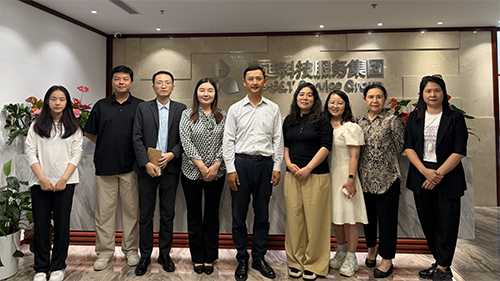
The visitors spoke highly of TusHoldings' mature innovation operation system, comprehensive sci-tech service ecosystem, and solid track record in industrial development. During the meeting, the visiting team outlined the global presence, capacity-building work, and international resources of the UN Sustainable Development Goals institutions, as well as Tsinghua SPPM's foundations and cooperation interests in hosting SDG competitions, cultivating youth innovation and entrepreneurship, sustainable development research, and international degree programs. The two sides found their philosophies closely aligned and their resources strongly complementary across areas such as sci-tech incubation, co-hosted youth entrepreneurship competitions, global innovation network building, support for technology projects going global, and sustainable development practice—a solid foundation with broad prospects. They looked forward to using this exchange to establish a regular communication and coordination mechanism, carry out in-depth practical collaboration across multiple areas, and explore a long-term, sustainable cooperation model that benefits all parties.
The meeting opened effective channels for connecting resources across the parties, further consolidated consensus, and clarified the direction of cooperation. Going forward, all parties will build on their respective strengths, deepen regular exchanges, focus on precise alignment in priority areas, and work together to deliver tangible results—jointly empowering industrial innovation and upgrading and high-quality regional development.




Scan QR Code
Shared a Link


New Media


