


- Press Center

Advancing Sustainable AI Development Worldwide: UN Office for Digital and Emerging Technologies Visits TusHoldingsPrint
Post Time:2026-08-25来源:TusHoldings
On August 24, Mehdi Snene, Chief AI Officer of the UN Office for Digital and Emerging Technologies and Senior Advisor to the UN Secretary-General's Envoy on Technology, visited TusHoldings, accompanied by a delegation including Gao Ling, Executive Director of the Global SDGs and Leadership Development Center. Discussions focused on how developing countries can build sovereign AI capabilities, how to identify and deploy vertical applications suited to local needs, and how to allocate computing power efficiently. The delegation was received by Wang Jiwu, Chairman of TusHoldings; Yang Ming, Vice President of TusHoldings and Executive President of Tus S&T Service Group; and Zhang Youliang, Senior Vice President of TusHoldings and Chairman of the Zhixiang Huanyu Global AI Association.
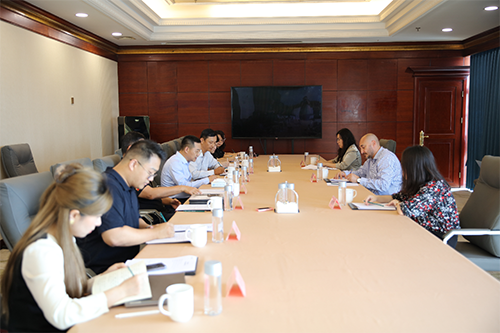
During the meeting, Mehdi Snene outlined the global AI landscape and the United Nations' plans to support AI development in the developing world. He noted that many developing and smaller countries face a common set of obstacles—a shortage of AI talent, limited technical capacity, and little hands-on deployment experience—and urgently need systematic external support.
He shared that the UN has brought together 26 member states, including 12 African countries as well as China, Germany, Brazil, and Cambodia, to prepare an AI alliance network and explore how artificial intelligence can drive development in member states. Looking ahead, international AI cooperation could be tailored to each country's actual needs, helping member states build sovereign, privately deployed national AI platforms. The UN also plans to develop a global AI implementation blueprint for all member states, setting out pathways for building national AI capabilities, arrangements for opening up computing resources, and operating models capable of generating stable long-term returns. Enterprises and private capital are expected to take part, bringing AI projects to life through market-based, commercial approaches. Mehdi Snene warmly invited TusHoldings to share with member states its extensive experience in sci-tech incubation and global innovation network building.
Chairman Wang Jiwu warmly welcomed the UN delegation. He said TusHoldings is committed to building a global sci-tech innovation network—a vision closely aligned with the UN Sustainable Development Goals. China attaches great importance to South-South cooperation, and TusHoldings has worked with many countries on AI and innovation projects, building solid experience in delivering projects overseas. Drawing on its strengths, TusHoldings can bring together computing power, technology platforms, industry application scenarios, sci-tech enterprises, and its global incubation network to offer countries a complete AI development solution. Beyond technology, TusHoldings can also help partner countries cultivate local innovation ecosystems, incubate local sci-tech enterprises, and connect with global industrial resources to jointly build AI cooperation frameworks—an approach already being rolled out in Africa and other developing regions. At the same time, while deepening South-South cooperation, TusHoldings continues to engage with sci-tech institutions across Europe and the United States in fields such as AI and life sciences, as illustrated by the life science companies it has brought from TusPark Cambridge to China.
Wang Jiwu noted that, as a sci-tech innovation services provider, TusHoldings delivers projects on a market basis and already operates in Indonesia, Cambodia, Saudi Arabia, Kazakhstan, and other countries. With the backing of the UN platform, these projects could be standardized and replicated, significantly accelerating their rollout.
He put forward three proposals: first, TusHoldings would send representatives to UN-hosted AI events and conferences; second, it would second technical experts to take part in the UN's thematic AI work; and third, the two sides would jointly select several countries for flagship AI cooperation projects as a focus of future collaboration.
After the in-depth exchange, Mehdi Snene concluded that both sides share the same goal of harnessing AI to build capacity in developing countries. TusHoldings' mature industrial ecosystem, global network, and proven delivery capabilities are an excellent match for the UN's international cooperation agenda. Given how fast the AI industry evolves, he said he would begin planning next steps as soon as he returned. The two sides agreed to convene a joint workshop to identify pilot countries, priority application scenarios, and participating enterprises, and to work out concrete plans for flagship projects that will take the cooperation forward.
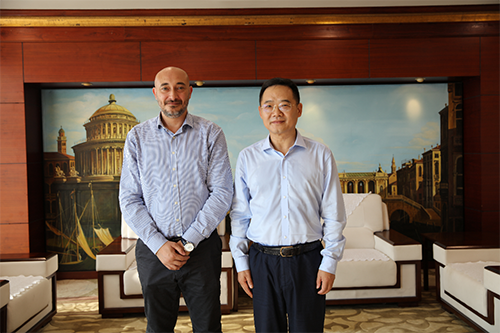
Before the meeting, Liu Zhenzhen, Director of China Affairs Development at TusHoldings UK, accompanied the UN delegation on a tour of the TusHoldings Digital Showroom, presenting the company's history, sci-tech incubation system, and global innovation network.
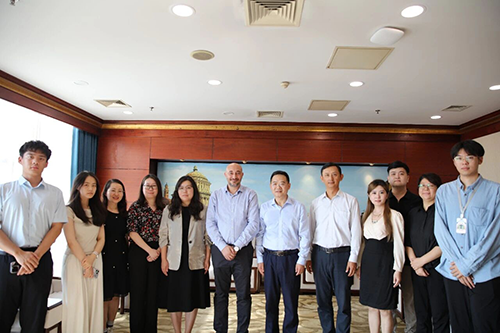
Also attending were Zhou Yun and Cheng Jin, Deputy Secretaries-General of the Zhixiang Huanyu Global AI Association; Mao Yanxuan, Deputy General Manager of the Overseas Business Department; Liu Yuanzhi, Secretary to the Chairman of TusHoldings; and Zhang Yumin, International Cooperation Project Manager at TusStar.




Scan QR Code
Shared a Link


New Media


